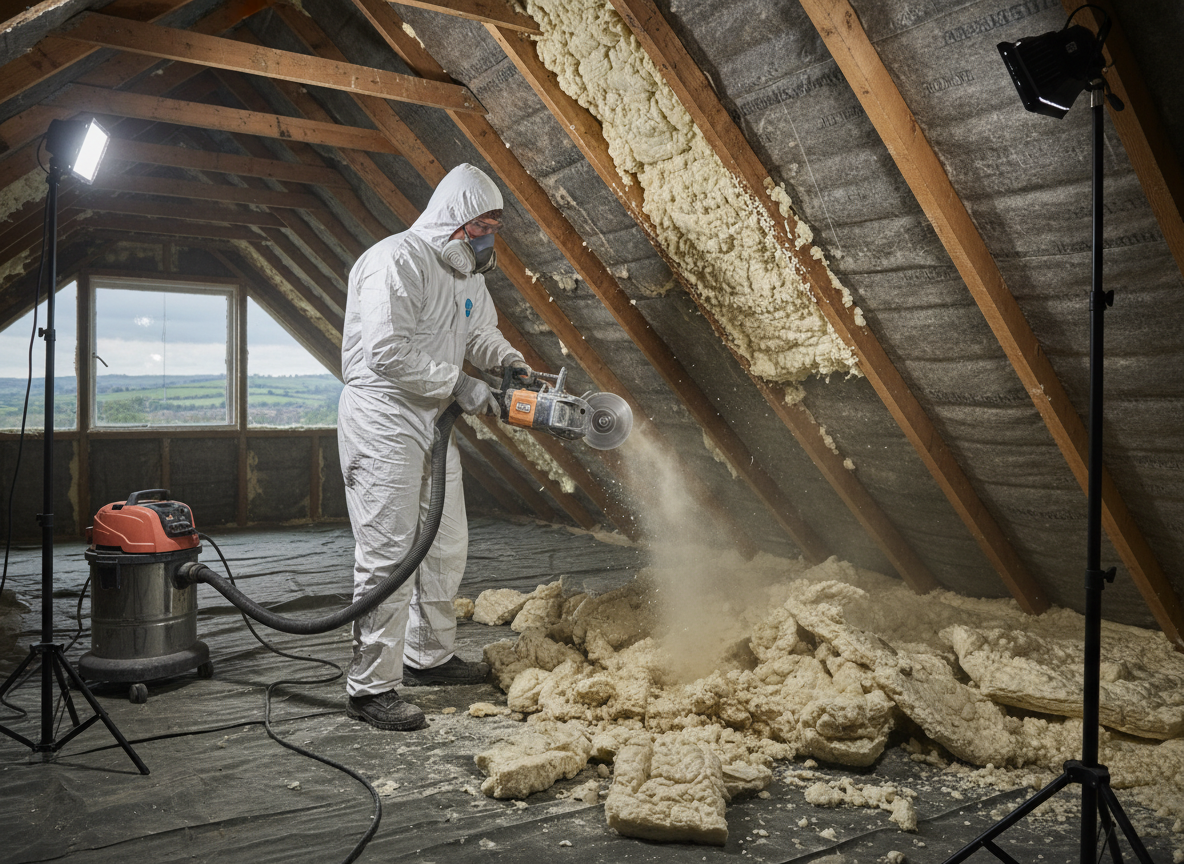
Cheltenham's Victorian and Edwardian terraces often have spray foam applied directly to lath and plaster or between rafters in the 2000s and 2010s. Removing it requires careful cutting around original timbers and ventilation stacks without damaging the roof structure. Wet winters in Gloucestershire mean any remaining foam residue can trap moisture against the ceiling, leading to hidden mould growth that only becomes visible once the foam is gone.
Edge cases include properties near Montpellier and Pittville where narrow loft hatches and shared chimney stacks complicate access and debris removal. Closed-cell foam bonds tightly to slate roofs common in the area, so crews must work in sections to avoid dislodging tiles. Homeowners frequently discover the foam was installed over existing mineral wool, creating a double layer that doubles the extraction time and waste volume.
Regulation notes for the Cheltenham area include checking that removal does not compromise fire separation in terraced houses and ensuring new insulation meets current building standards before re-boarding. Dust containment is critical because many lofts sit above bedrooms and the fine particles travel easily through floorboards into living spaces below.
Technician insight
In Cheltenham, the thing that catches most people out with loft spray foam removal is how often the foam was sprayed straight onto the original lath and plaster in pre-1910 terraces around Montpellier and Lansdown. Once you start pulling it, whole sections of ceiling can come away if the plaster keys have already failed from years of trapped condensation.
Pittville Terrace Loft Clearance
Homeowner in a Pittville terrace noticed musty smells after heavy winter rain. Inspection found closed-cell foam over the original ceiling with moisture trapped underneath. We removed the foam in sections, cleaned the rafters, and confirmed the lath and plaster remained sound. New breathable insulation was recommended instead of re-foaming.
How it works
- 1
Site Assessment
Inspect loft access, foam type, and any hidden wiring or pipework in Cheltenham properties before starting removal.
- 2
Containment Setup
Seal the loft hatch and floor with sheeting to stop dust migrating into bedrooms and living areas below.
- 3
Foam Extraction
Cut and peel foam in controlled sections, bagging waste immediately to limit airborne particles.
- 4
Surface Cleaning
Remove residue from rafters and ceilings, checking for damp or mould before any new insulation is considered.
Pricing
Upfront quotes provided after inspection; cost depends on loft size, foam thickness, and access difficulty.